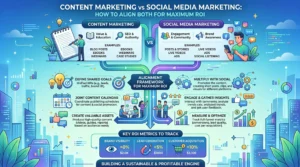


- Long-Term vs. Short-Term Value: Content marketing builds long-term digital equity and evergreen traffic, while social media marketing provides immediate engagement and direct communication.
- Owned vs. Rented Media: Content marketing operates primarily on your owned channels (websites, blogs), whereas social media relies on third-party networks subject to changing algorithms.
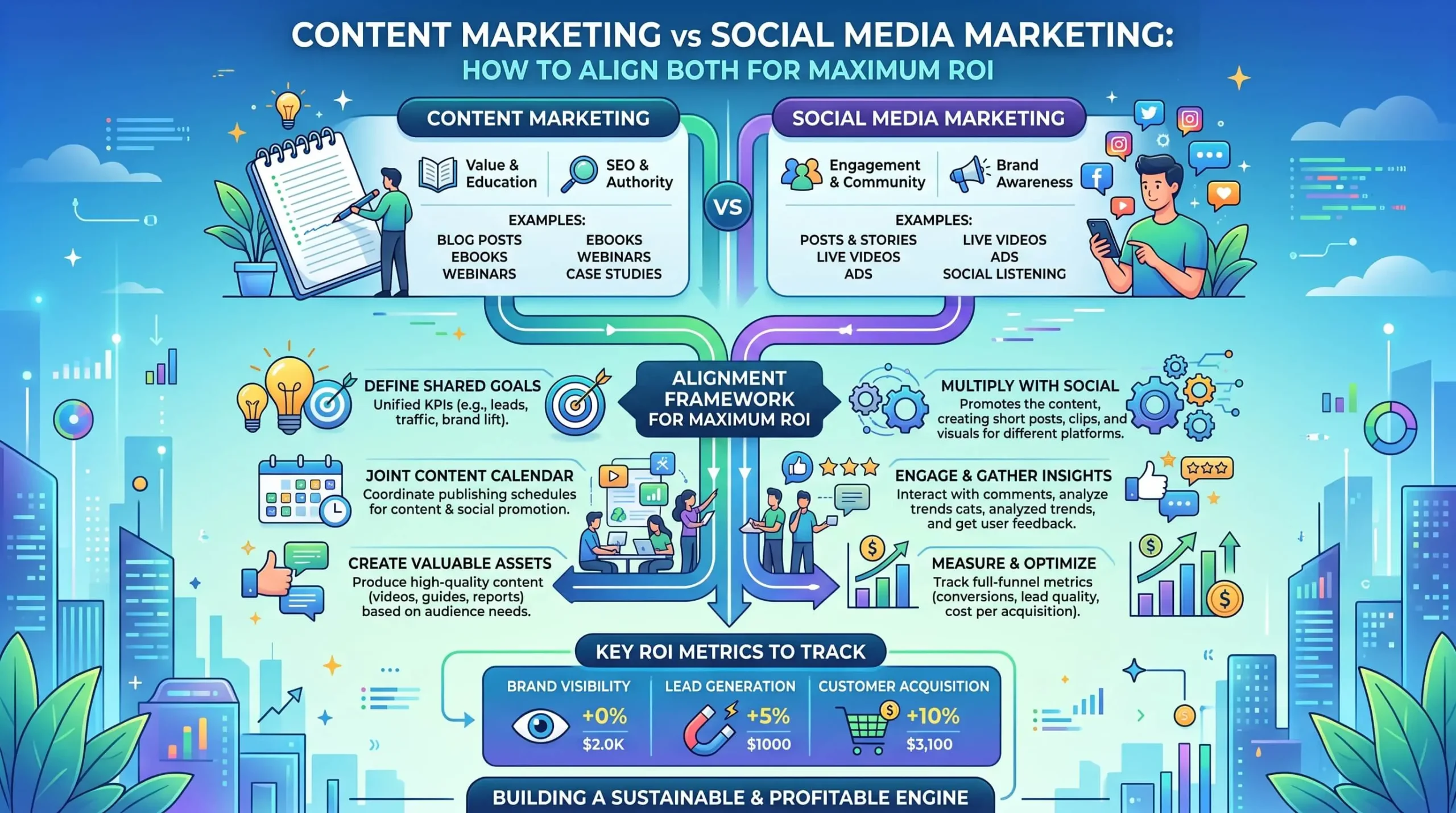
- The Power of Synergy: Combining both strategies maximizes return on investment (ROI) by using social media to distribute owned assets and using social data to guide content creation.
- Optimization is Critical: Integrating keyword research and strategic content optimization ensures your efforts drive sustainable organic traffic over time.
Introduction: Understanding the Digital Marketing Landscape
In the expansive and ever-evolving digital marketing landscape, businesses often treat content marketing and social media marketing as interchangeable practices. It is easy to see why. Both strategies rely on creating compelling copy, engaging graphics, and high-value media to capture target audiences. However, confusing these two pillars can lead to misallocated budgets, disjointed campaigns, and missed opportunities. To establish a highly profitable digital footprint, marketers must recognize that while these disciplines are closely related, they serve fundamentally different roles in a brand’s overall strategy.
At its core, content marketing is a long-term approach focused on building and distributing valuable, relevant, and consistent assets on owned platforms. Its ultimate goal is to solve customer problems, build brand authority, and attract consistent organic traffic. On the other hand, social media marketing focuses on leveraging third-party networks to facilitate direct customer conversations, drive brand awareness, and promote specific campaigns in real time. Rather than choosing one over the other, high-growth organizations implement cohesive SEO strategies that enable both channels to support, amplify, and optimize each other. Understanding how to align these forces is the key to unlocking maximum marketing ROI.
Key Differences: Content Marketing vs. Social Media Marketing
To construct a balanced digital strategy, you must understand the operational boundaries of both disciplines. Each possesses unique formats, distinct distribution networks, and varying shelf-lives for their respective assets. While content marketing aims to establish permanent digital hubs that secure a high search engine ranking, social media marketing thrives on high-frequency, ephemeral touchpoints designed to capture attention quickly and foster active community participation.
While content marketing generates a cumulative compounding effect—delivering continuous organic traffic years after publication—social media relies on a rapid-response feedback loop. The following table highlights the critical distinctions between the two methodologies:
| Metric/Dimension | Content Marketing | Social Media Marketing |
|---|---|---|
| Primary Channels | Owned Media (Company Blog, Resource Centers, Hubs) | Rented Media (LinkedIn, Instagram, X, TikTok, Facebook) |
| Primary Objectives | Education, lead generation, customer retention, brand authority | Brand awareness, customer service, direct community engagement |
| Average Content Shelf-life | Long-term (Months to Years) | Short-term (Hours to Days) |
| Primary Traffic Type | Organic traffic via search engine queries | Social referral and viral traffic via algorithms |
| Success Metrics | Search rankings, organic sessions, leads generated, conversion rates | Likes, shares, comments, video views, click-through rates |
As illustrated, neither channel is inherently superior. Instead, they represent two different engines within the same marketing machine. Content marketing serves as the foundation of your digital real estate, while social media serves as the dynamic highway that directs traffic straight to your front door.
The Core Pillars of Content Marketing
Content marketing is the process of planning, creating, and sharing high-quality assets to convert strangers into loyal advocates. Unlike transactional advertising, it is educational and value-first. When executed correctly, content marketing turns your website into a comprehensive industry resource, which signals credibility to both human readers and search engine crawlers.
The foundation of any successful content strategy relies heavily on keyword research. By understanding exactly what your target audience is searching for, you can construct deep-dive blog posts, whitepapers, and guides that address their specific pain points. This structured approach directly influences your search engine ranking, allowing your brand to appear at the exact moment a prospective buyer is seeking answers. Over time, this compounding presence builds trust and yields a steady flow of high-intent organic traffic, reducing your reliance on expensive paid advertising campaigns.
Furthermore, because your content lives on your owned domain, you retain full control over the user experience and lead capture mechanisms. Whether you are using a detailed guide to build an email subscriber list or a product comparison page to drive direct trials, content marketing functions as the ultimate engine for long-term lead generation and nurturing.
How Keyword Research Drives Long-Term Content Success
At the center of any enduring content marketing strategy is a robust process for identifying user intent. Without proper keyword research, you risk creating content that, while well-written, fails to address the queries your audience is entering into search bars. To ensure your long-form articles do not get lost in the digital noise, you must match your expertise with the specific search phrases used by your prospective buyers.
Aligning your content with search intent is a multi-step process that dramatically improves your search engine ranking:
- Identifying Intent: Determine whether users are looking for information (informational intent), comparing products (commercial intent), or ready to buy (transactional intent).
- Analyzing Keyword Competitiveness: Target high-value, low-competition keywords to build initial domain authority before attempting to rank for highly competitive industry terms.
- Answering Complex Queries: Structure your content to directly answer user queries using clear headings, structured tables, and concise definitions, which increases your likelihood of earning Google’s coveted featured snippets.
By treating keyword selection as a strategic blueprint, you ensure that every article published is a long-term asset designed to consistently pull traffic into your funnel.
The Core Pillars of Social Media Marketing
If content marketing is the long-form encyclopedia of your brand, social media marketing is the daily news flash. Social media is fast-paced, highly conversational, and deeply visual. Its primary strength lies in its ability to humanize your business, allowing you to speak directly with your audience, receive immediate feedback, and build a vibrant community around your products or services.
Unlike search engines, where users actively seek out specific solutions, social media networks rely on discovery algorithms. Users browse social feeds for entertainment, connection, and inspiration. Therefore, the core pillars of social media marketing center around eye-catching creativity, cultural relevance, and immediate engagement. High-performing social strategies focus on fostering two-way dialogues rather than broadcasting one-sided sales pitches.
Additionally, social media serves as an invaluable listening tool. By monitoring mentions, comments, and trending topics, brands can gain real-time insight into audience pain points, industry trends, and competitor weaknesses. This immediate connection allows companies to pivot their messaging quickly, offer rapid customer service, and build a level of brand affinity that static web pages simply cannot achieve alone.
Synergy: How to Integrate Content and Social Media Marketing
True marketing excellence is achieved when these two disciplines stop operating in silos and start working in harmony. Relying solely on content marketing can result in a slow path to visibility, while relying solely on social media keeps you trapped on an algorithmic treadmill where you must constantly create new posts just to maintain reach. By integrating both through comprehensive SEO strategies and smart distribution, you create a self-sustaining marketing flywheel.
For instance, every piece of long-form content you publish should serve as the source material for your social channels. When you produce a comprehensive guide on your blog, your social media team can break that asset down into multiple bite-sized graphics, discussion prompts, and video scripts. Conversely, the questions and discussions occurring on your social channels can inform your future editorial calendar. If a LinkedIn post or a TikTok video sparks an intense debate or receives numerous follow-up questions, that is your cue to conduct keyword research and write an in-depth blog post addressing that specific subject. This integrated loop maximizes your investment in both creative and analytical resources.
Maximizing Reach Through Content Optimization and Repurposing
Producing high-quality content takes time, budget, and talent. To achieve a strong return on your investment, you must extract every drop of value from every piece of media you create. This is where content optimization and strategic repurposing come into play. Instead of viewing a blog post as a single web page, look at it as a multi-format content library waiting to be unlocked.
By utilizing data-driven SEO strategies, you can design your primary assets to be easily deconstructed. For example, a single comprehensive guide can be systematically broken down into several smaller promotional assets:
- Infographics: Convert complex statistical data or step-by-step processes from your blog post into visually appealing graphics for Pinterest, Instagram, and LinkedIn.
- Short-form Videos: Take key takeaways or bold assertions from your article and script them into 60-second video clips for YouTube Shorts, Reels, or TikTok.
- Interactive Threads: Turn the logical flow of your written content into highly engaging text threads on X or LinkedIn to spark professional commentary.
“Repurposing content not only expands your reach across different demographics but also reinforces your brand messaging, ensuring your audience encounters your insights in whatever format they prefer to consume.”
This process of continuous content optimization ensures that your social media feeds remain active and value-rich without requiring your team to write new articles from scratch every single week.
Key Takeaways: Which Strategy is Best for Your Business?
When deciding how to allocate your marketing budget, you should not ask which strategy is better, but rather how to balance them based on your current business stage and immediate objectives. Both pathways ultimately lead to growth, but they do so on different timelines and require different resource allocations.
- Prioritize Content Marketing if: You want to build sustainable, long-term brand authority, reduce your reliance on paid customer acquisition, and generate passive, high-intent organic traffic over time. This approach is highly recommended for B2B enterprises, SaaS organizations, and complex service providers with long sales cycles.
- Prioritize Social Media Marketing if: Your business relies on immediate brand awareness, visual storytelling, or daily customer engagement. This is critical for e-commerce brands, local event spaces, lifestyle products, and direct-to-consumer businesses that thrive on impulse purchases and trending topics.
- The Balanced Budget Blueprint: For most growing companies, the ideal split involves dedicating roughly 60% of resources to establishing long-form content assets and 40% to social media amplification and community management. This ensures you are simultaneously securing your future market share while staying relevant in the present moment.
Frequently Asked Questions (FAQ)
Which strategy produces faster results: content marketing or social media marketing?
Social media marketing generally produces much faster results. Since social networks are designed for real-time interactions, a well-timed post, paid ad, or viral video can generate immediate traffic, brand awareness, and conversions within hours. In contrast, content marketing supported by robust SEO strategies is a long-term investment. It can take three to six months for optimized blog posts to start climbing the search results and delivering substantial organic traffic.
Does social media activity directly impact my website’s search engine ranking?
While social media shares, likes, and comments do not act as direct ranking signals in Google’s core algorithm, they do have a powerful indirect effect. Active social promotion drives high volumes of targeted traffic to your site, increases brand searches, and attracts natural backlinks from bloggers and journalists who discover your assets on social networks. All of these factors contribute to improved authority and better visibility in search engines.
How often should I review my content optimization strategy?
You should review your content optimization strategy at least quarterly. Search algorithms change, competitors publish new material, and user search behavior evolves over time. Regular audits allow you to identify declining pages, update outdated information, add fresh keywords, and ensure your internal linking structure continues to support your primary business goals.